Showing posts with label Copenhagen. Show all posts

Sunday, January 24, 2010

The Flat Earth Society Is Alive And Doing Well In Saudi Arabia


As the world, at least most of the countries in the world, express concern and even regret over the failure of the Conference at Copenhagen to come to a meaningful conclusion the Saudi Arabian chief negotiator at the talks expressed Saudi Arabia’s glee and satisfaction that the Copenhagen Conference failed to take any positive steps towards meeting the most important challenge that civilization has ever met. Mr. Mohammad Al-Sabban went further as to predict that the world seems to be heading towards a stalemate on the question of anthropomorphic global warming, AGW. Mr. Al-Sabban proceeded on an interview on the BBC to predict that the action on climate change will become similar to that on the Doha round of the WTO. The WTO members have been engaged in negotiations for the past ten years with no resolution in sight.

It is shameful that a country takes pride in the fact that it is not likely for the world community to make any progress on the climate change issue for at least the next ten years and furthermore Saudi Arabia is proud of its record on AGW because it was essentially the work of a China-Sudan-Saudi Arabia cabal that sank the Copenhagen Conference. Saudi Arabia’s obstructionist role in Copenhagen earned it the moniker the” most likely villain in the awkward squad”.

When the world was initially presented with the problem of AGW, many countries, institutions , scientists and individuals were skeptical until the world scientific community has practically united in adopting the view that human activities are the culprit behind climate change. It has been estimated by the scientific community that any change greater than 2 degrees Celsius will have profound global catastrophic implications that range from disease , to storms, higher ocean levels, food shortages and extinction of specie. The fact that human civilization has become a major evolutionary force can be seen in numerous scientific studies.

The Proceeding of the National Academy of Science concluded that “ Since 2000, a growing global economy, an increase in the carbon emissions required to produce each unit of economic activity, and a decreasing efficiency of carbon sinks on land and in oceans have combined to produce the most rapid 7-year increase in atmospheric CO2 since the beginning of continuous atmospheric monitoring in 1959. This is also the most rapid increase since the beginning of the industrial revolution.”

And the Intergovernmental Panel on Climate Change, IPCC, has also said that :” Warming of the climate system is unequivocal, as is now evident from observation of increases in global average air and ocean temperatures, widespread melting of snow and ice and rising global average sea level. Observational evidence from all continents and most oceans shows that major natural systems are being affected by regional climate changes, particularly temperature increases.”

In light of all the scientific evidence from all over the world that climate change is a fact , that its effects will be dramatic, that it is our duty and obligation to try to mitigate it Saudi Arabia is glad that we are not planning any action. But that position is to be expected. Would we expect the drug pusher to support measures designed to decrease drug usage? Of course not. To allow Saudi Arabia and China to have a major say in how to deal with global warming is similar to the proverbial image of putting the fox in charge of the hen house. I am not sure that Saudi Arabia and possibly all other major exporters of fossil fuels should have a say in what is to be done in order to implement strong steps that are bound to create major withdrawal symptoms but that are necessary if the addict is to be given a chance to overcome the addiction. Saudi Arabia and all the other 25 countries in its camp have prevented the global community from making any progress towards rehabilitation and sustainability by insisting that the world is flat. Such a position is demonstrably evil and unethical. But that fact that the global community allowed the "Awkward squad" to carry the day is a powerful statement about our lack of resolve. Shame on all of us.

Monday, November 30, 2009

A Sleight Of Hand


The lack of commitment to deal with the various aspects of the ecological challenges that civilization is facing is difficult to accept by those who believe that we are wise specie. But what if we are not? Could it be that we are much more interested in computing the number of angels that can dance on the top of a pin while the barbarians are at the gate? So much suggests that we have no interest in saving ourselves if that implies taking steps that demand change and sacrifice. I guess that in a weird kind of way we are in essence using a strange Cost-Benefit analysis that concludes that the cost of sustainability outweighs the benefits derived from it.
An excellent example to demonstrate the above can be seen in the calculations used to offset carbon footprints. The logic behind these calculations is simply astounding, astoundingly bad. Here is a brief explanation of how this is supposed to work. Large global corporations in the United States could buy vast areas of the tropical forest in Brazil for a relatively small some of money. Once the purchase is completed these international firms will send a group of consultants to number , measure and catalogue the trees in that “preserve” This would enable the owners of the forest, say GM, to estimate the volume of carbon that has been sequestered within the biomass of each of the trees. Some of the common estimates assign often 100 Kg of carbon to each tree. That is 1/10 of a ton and so if a ton of carbon on the exchanges is trading for say $20.00 then that typical tree has a value of $2.00. Furthermore we can assume that each acre has 400 trees and that the area of the preserve is 100,000 acres. The quick calculations show then that this preserve has trees whose value is $80 million of sequestered carbon. So why did GM buy this forest? Because GM is now in a position to claim a carbon credit worth 40,000 tons of carbon. GM can use this credit to offset part of its footprint or it can elect to sell this credit on an open market.
Did you follow the clever sleight of hand? The magic wand of the market created a certain sum of carbon and sold the right to a polluter. We convince our selves that we are polluting less when we are polluting more. Its sheer madness.

Sunday, November 01, 2009

Copenhagen, One more Time


The peace Nobel laureate Desmond Tutu sent a letter to the EU parliament in which he berated them for not acting to slow down climate change. Mr. Tutu said in his letter " The rich world is historically responsible for the emissions causing climate change and they have a moral obligation to provide the means for the countries on the front line to survive and prosper."

Mr. Tutu was in effect urging the countries of the North to overcome their differences and to live up to their moral responsibility by agreeing; during the Barcelona negotiations; to find a way out of the current impasse before Copenhagen . The developing countries have made it clear that they expect financial transfers from the developed countries of around $148 billion a year by 2020 if they are to do their part of reducing their expected carbon footprint.

But since climate change is a global issue then it does require a global solution. Again it seems obvious that we cannot have a global solution if the largest, well second largest , emitter is not ready to participate in the game. Copenhagen is exactly one month away and the US climate change bill is still languishing in the Senate sub-committee. Senator Boxer , the chair of the Environmental Committee, remains hopeful that a bill will leave her committee before Copenhagen. That is not assured because a number of the Republican senators promise not to attend the committee mark up sessions. If they do not attend then no bill can be presented to the senate at large. Even if a bill is to emerge some very powerful Democratic senators such as Max Baucus promise to hold up the measure in his powerful Finance Committee by delaying funding for the measure. What is even worse are the proposed targets. Kyoto which was initially agreed to by the US was to cut carbon emissions by 5 % from the 1990 level by 2012. The US is estimated to have released around 5 Billion tons of carbon in 1990 and thus the implicit target by 2012 would have been 4.75 billion tons.The new bill is aiming for a 20% reduction from the 2005 levels by 2020. Since the 2005 emissions are estimated to be 6 billion tons then the 20% reduction will take the US back to 4.8 billion tons by 2020. That is irresponsible behviour besides being a cruel joke on the aspirations of those that take these existential matters seriously. The US is targeting to potentially reach by 2020 a level of carbon emissions that it was supposed to have hit by 2012 and yet they want the world to call such measures responsible action. Go figure.

Mr. Yao de Bar, the UN Climate Change Secretariat said it best when he stated the need to "Step back from self interest and let common interest prevail" Nothing else will work.

Sunday, October 18, 2009

TANSTAAFL


“There ain’t no such thing as a free lunch” has been traced to the late nineteenth century when saloons in the US offered free lunch for their paying customers. Obviously the idea has since become a corner stone of economics by emphasizing that whenever we make a choice then we have to sacrifice something else in exchange. The same principle governs all activities in the scientific world that is governed by the entropic nature of the universe. We can never produce something out of nothing.
It is unfortunate, in light of the above, that so many thinkers, institutions and organizations have chosen to remedy what is arguably the greatest challenge to civilization; environmental degradation; by advocating policies that are not guided by that most basic of ideas. Sustainability, an inevitable phenomenon of an increasingly complex systems, is being promoted by each and every government in the world, by the United Nations and all its agencies and many think tanks and educational institutions of higher learning through arguments and models that seek more economic growth when it is very clear that sustainability came to the forefront; as an existential issue; as a result of the destructive activities of economic growth. Major concerns about sustainability, the ability to continue the current scale of operations into the future demands that we adopt a radically different methodology rather than the current paradigm that glorifies economic growth and unfettered markets. As the proverb says "If you always do what you've always done, then you'll always get what you always got." Business as usual will only result in severe shortages and unthinkable environmental degradation.
Kenneth Boulding, the preeminent economist is reputed to have said: “Only mad men and economists believe that infinite growth is possible in a finite world”. He actually went further as to characterize that kind of irresponsible behavior as a “cowboy economy” when he suggested that we need to think of the delicate balance of a “spaceship” earth. A society without limits is a fiction.
This idea of the absolute need for limits to growth has been adopted by many thinkers in all sorts of fields, physics, anthropology, biology, ecology, philosophy and economics just to name a few. But the most effective proposition has been the one made by Herman Daly who revived the old idea of the classical economists in general and that of J. S. Mill in particular, namely steady state economics. This notion has become the foundation for all environmental visions that seek to steer human activity in such a way as to avoid the imminent collapse that we are heading towards. How far are we from the abyss is debatable but many of the models such as the Club of Rome, global ecological footprint, Pimentel estimates of the limits to the size of global population or the Energy Return on Investment (EROI) speak in terms of decades and not centuries.
Add to the above the bleak Environmental assessment of the group of 1300 scientists assembled by the UN, the dreadful outlook of James Hansen of NASA about the severity of the upcoming climate change in addition to the dire predictions of James Lovelock who has been described as “one of the environmental movement’s most influential figures” and one cannot help but be bewildered when we hear the politicians suggest more growth when it was growth that created the problem in the first place. When would we understand that more of the same is a recipe for disaster and that sustainability is not compatible with economic growth. It is simply one or the other.
Under the best of circumstances growth can be justified as a means to an end but it is pure madness when growth becomes an end in itself as it has become in the developed world. Why is it so difficult to connect the dots and conclude that since pollution is a by product of economic activity and since economic growth demands a greater scale of human activity then economic growth is the cause of environmental degradation. Maybe when all is said and done Homo sapiens (wise humans) we are not.
The world is at a critical proverbial fork in the road. We can either change direction and hope that we can avoid the abyss or we can pretend that there is a free lunch and we can have it all, economic growth and sustainability in a finite world. The choice is very clear, either follow the principles and the models that show unmistakably he absolute need for a radical change in the whole architecture or continue the pretense that we can have our cake and eat it too. Lipstick on a pig just won’t cut it.

Sunday, October 04, 2009

Copenhagen, Again.


"Progress toward high industrialized world emissions cuts remains disappointing during these talks. We're not seeing real advances there," Yvo de Boer, the head of the U.N. Climate Change Secretariat, told reporters.
That just about sums up all the progress or disappointment at the on going pre Copenhagen discussions taking place at Bangkok, Thailand. The discussions are scheduled to end on October 9, 2009 and are being attended by delegates from 180 different countries who are attempting to nail down a global agreement to cut carbon emissions that will be finalized at Copenhagen. Unfortunately , the differences between the developed world and the developing world are just as wide as they have ever been. Even the targets for the developed world seem to be way out of reach.
Such an outcome should not be surprising to all of those who are familiar with the logic behind the “Tragedy of the Commons”. Each country wants to decrease the cost of its own targets hoping that somebody else will pick up the slack. When each country attempts to lower its own cost by shifting it to another country then the earth suffers because the global targets will be missed and only ruin will result.
The US position has posed the greatest challenge to the participants so far. "Not knowing what the United States is going to be able to bring to Copenhagen really makes it very difficult for other countries in that Kyoto discussion to increase the level of ambition of their numbers," said John Ashe, a senior diplomat who chairs a key U.N. group negotiating expanded Kyoto commitments. So far it does not look very promising for the developed world to agree on the up to 40% carbon emissions cut by 2020 from the 1990 levels that scientists deem to be essential.
To make things even more complicated the developing nations refuse to accept anything less than a 40% cut by the developed world in addition to financial transfers that do not appear to be forthcoming. As you can see both sides are playing a game of chicken when the health of the entire planet is at stake.

Saturday, September 26, 2009

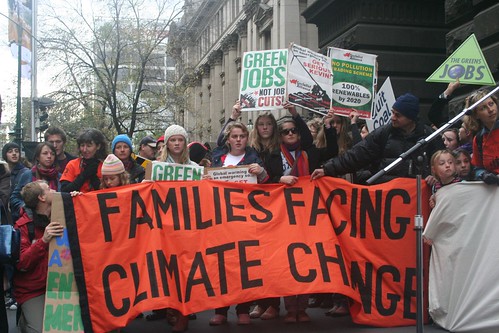
Can Copenhagen Deliver on its Promises?


We are already witnessing the beginnings of a barrage of saturated media coverage about climate change and the upcoming Copenhagen conference. By the time the COP15 Conference at Copenhagen arrives it might be the only item in the news all over the world and that is good. We need to take some meaningful measures that could get us to move in the right direction. Who knows, we might even avoid the apocalypse.
The failure to reach an agreement to adopt an effective and clear plan of action to reduce greenhouse gas emissions would be a major setback to the environmental efforts to avert a catastrophic climate change, an increase in temperature greater than 2 degrees Celsius. Sea level will rise, major ocean currents would be disrupted, monsoons and hurricanes will increase both in their frequency and intensity, crop failures will become more common, desertification will increase; life as we know it will become disrupted. What is at stake is surely the greatest challenge that civilization has ever faced and a successful Copenhagen meeting is a must.
Yet if we are to act as dispassionate observers of this process we will have no choice but to note the major logical fallacy upon which Copenhagen is built. The issue is not whether the world can afford not to decrease its GHG emissions; it can not. The real issue though is whether Copenhagen can deliver us out of this self inflicted quagmire? How can it possibly do that when we even refuse to look into the root cause of this problem? Anthropogenic emissions are simply the product of human economic activity and no one is proposing that we limit economic growth. The position at Copenhagen is nothing else but an exercise in a combination of major logical fallacies such as “argumentum ad populum” combined with “argumentum ad baculum”; a false argument based on the appeal to the majority and to fear.
Let me explain. One of the major efforts that the nations, represented at Copenhagen, will confront is that of reducing car emissions. It is widely believed that the move to hybrid engines and electric plug-in vehicles, in addition to more efficient engines, will turn out to be a major contribution in achieving the sought reduction in carbon emissions. But would it? The world produced over 70 million new vehicles during 2007 but under the best estimates all the hybrids and electric plug-in will not amount to more than 2 million units a year by 2015. If these numbers hold then that is a miserly 2% of the new cars, not to mention that China and India alone are slated to replace the United States as the number one producers of vehicles in the world. Emissions from China and India, both of whom are neighbours of Bangladesh, will not be regulated. Climate change is the largest infringement on the sovereignty of Bangladesh and yet it goes on each day of the year without firing a bullet or creating a political standoff. Even if we are to assume, as unlikely as it might be, that by 2020 one fifth of the newly manufactured in the world each year would be powered by either a hybrid or an electric engine, what about all the raw materials that has to be mined and processed in order to build all of these cars not to mention all the tires, spare parts, accidents and highways that they will generate and require? Would supplying all of these resources by “developing” countries be without a carbon footprint?
A more efficient car is a welcome development but a more efficient car will be useless in reducing the human impact on the ecosystem unless we are to simultaneously build fewer cars and consequently fewer garages, less highways, less spare parts use less resources and conserve our natural capital.
It is not sufficient to set up a goal. We must set up a goal accompanied by a workable plan otherwise the goal would best be classified as a wish. Imagine ,if you will, that all the water bottling facilities in Fiji ; whose products are shipped to North America and the rest of the world; are to become totally powered by energy acquired through either thermal solar , photovoltaic or wind turbines, would that then make the consumption of such water environmentally friendly? You decide.
As you can see from the above the need to cut down on GHG’s and carbon emissions is not questioned. What is at stake is our ability, or rather inability, to accept that climate change is nothing more than a manifestation of a systemic failure and such failures demand a total redesign of the system. If we cannot understand this most basic of all facts then all our efforts, as well intentioned as they might be will be for naught.

A podcast of the above can be heard at: ramblings11.mypodcast.com